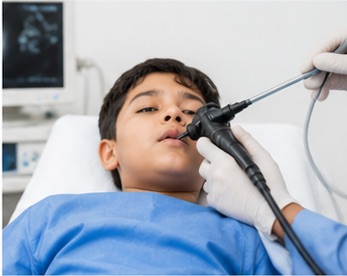
For parents, the prospect of any procedure involving their child's airways can feel frightening. But when a child is experiencing symptoms that cannot be explained by standard investigations — a cough that has lasted months, repeated chest infections affecting the same lung segment, or acute breathing difficulty following a choking episode — bronchoscopy provides information no other test can give.
Dr. Rajkumar Korra has performed over 1,500 bronchoscopies at Lalitha Chest and Skin Hospital and is experienced in paediatric airway assessment. This article explains why bronchoscopy is recommended for certain children and exactly what the procedure involves.
What Is Bronchoscopy?
Bronchoscopy is a procedure in which a thin, flexible tube fitted with a camera (fibreoptic bronchoscope) is passed through the nose or mouth, down the throat, through the vocal cords, and into the airways (trachea and bronchi). This gives the pulmonologist a direct, real-time view of the airway interior — its calibre, the condition of the mucosa, the presence of secretions, structural abnormalities, or foreign objects.
It can be purely diagnostic, or therapeutic — used to remove a foreign body, clear mucus plugs, or obtain a tissue biopsy.
When Is Bronchoscopy Recommended for Children?
Dr. Rajkumar Korra recommends paediatric bronchoscopy in situations including:
- Suspected foreign body aspiration — when a child has choked and continues to wheeze or cough despite initial management; bronchoscopy can locate and retrieve the object under direct vision
- Persistent or recurrent pneumonia in the same lobe — which may indicate an obstructing lesion, mucus plug, or anatomical abnormality
- Unexplained chronic cough or wheeze — not responding to standard asthma or infection treatment
- Suspected airway malacia (softening of the airway walls) or other structural abnormalities
- Investigations for interstitial lung disease — with bronchoalveolar lavage (BAL) sampling
- Assessment before or after airway surgery
The Procedure: Step by Step
Children undergoing bronchoscopy in our unit receive appropriate sedation and local anaesthesia to the airway — the level of sedation is tailored to the child's age, size, and the complexity of the procedure. Dr. Rajkumar Korra works alongside an experienced anaesthetics team for all paediatric cases.
The bronchoscope is introduced gently and the airways are inspected systematically. If a foreign body is found, a retrieval forceps or basket instrument passed through the bronchoscope removes it. If the procedure includes BAL (lavage), sterile saline is introduced and aspirated back, with the sample sent for culture, cytology, and biochemical analysis. The procedure typically takes 15–30 minutes for diagnostic cases; removal of foreign bodies may take longer depending on the object's location and characteristics.
Recovery
Most children are observed for one to two hours after the procedure and, in uncomplicated cases, can return home the same day. A mild sore throat, hoarse voice, and low-grade temperature are common and self-limiting. Parents are given specific instructions about warning signs — increasing breathing difficulty, high fever, or stridor after discharge — that would warrant immediate review.
A Word to Anxious Parents
Dr. Rajkumar Korra takes time before every paediatric bronchoscopy to explain the procedure to parents, answer all questions, and address concerns directly. An informed, prepared parent means a calmer child and a smoother procedure.
If your child's chest physician or paediatrician has recommended bronchoscopy, or if you are seeking a second opinion, please contact Lalitha Chest and Skin Hospital at +91 94413 59200, Opp. Adharshnagar Board, Choppadandi Road, Karimnagar – 505001. We are here to help your child breathe easier — with care, expertise, and patience.