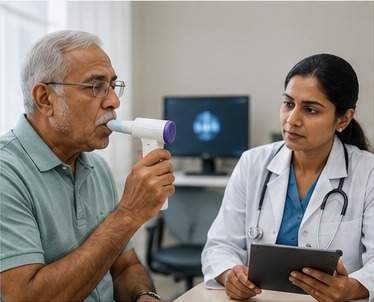
"The single most important thing I want patients to understand: if you have smoked bidis for 20 years and you are now breathless climbing stairs, that is not normal ageing. That is likely COPD, and a simple spirometry test — which takes 10 minutes — can confirm it. We can then start treatment that makes a real difference," says Dr. Rajkumar Korra, MD (Pulmonology), Consultant Pulmonologist at Lalitha Chest & Skin Hospital, Karimnagar.
What Is COPD?
COPD is a condition where the airways and air sacs of the lungs are permanently damaged, making it progressively harder to breathe. Unlike asthma, where airway narrowing is largely reversible, the obstruction in COPD is mostly fixed. Most patients have a combination of chronic bronchitis (persistent airway inflammation with productive cough) and emphysema (destruction of air sacs, leaving lungs unable to empty properly).
Causes — India's Unique COPD Epidemic
- Bidi and cigarette smoking — The single most important cause. Bidi smoke contains higher concentrations of harmful compounds than cigarettes. Men in rural India who have smoked bidis for 20+ years form the largest COPD group.
- Biomass cooking smoke — India's most under-recognised risk group. Women who cook on chulhas using wood, dung cakes, or crop residue in poorly ventilated kitchens develop COPD at rates rivalling male smokers.
- Outdoor air pollution — Chronic PM2.5 exposure causes cumulative airway damage over decades.
- Occupational exposures — Construction, quarry, agricultural, and cotton mill workers face years of heavy dust inhalation.
- Post-TB lung damage — Healed TB leaves airways scarred and distorted. Post-TB obstructive lung disease is a major and under-recognised cause of COPD in India.
Early Signs of COPD (Often Ignored)
- Chronic cough present for at least 3 months in 2 consecutive years — often dismissed as "smoker's cough."
- Morning sputum (balgam) — Daily morning expectoration is one of the earliest signs, but commonly dismissed as normal.
- Mild breathlessness on exertion — Initially only during significant effort (climbing stairs, carrying loads). Most people attribute this to ageing or lack of fitness.
- Frequent respiratory infections — Needing antibiotics for chest infections more than once or twice a year.
Progressive Symptoms (Moderate to Severe COPD)
- Breathlessness limiting walking, bathing, and dressing
- Persistent wheezing
- Barrel-shaped chest
- Blue lips and fingertips (cyanosis)
- Ankle swelling from heart strain
- Weight loss and muscle wasting
Each severe flare-up causes additional irreversible lung damage.
COPD Stages — GOLD Classification
- GOLD 1 (Mild) — Lung function ≥80% predicted. Often no symptoms. Many undiagnosed.
- GOLD 2 (Moderate) — 50–79% predicted. Breathlessness on exertion becomes noticeable.
- GOLD 3 (Severe) — 30–49% predicted. Significant breathlessness. Frequent flare-ups.
- GOLD 4 (Very Severe) — Below 30% predicted. Breathless at rest. May need oxygen. Life-threatening flare-ups.
How Is COPD Diagnosed?
Spirometry is the only test that confirms COPD — a simple breathing test available at Lalitha Chest & Skin Hospital. An FEV1/FVC ratio below 0.70 after bronchodilator use confirms fixed airflow obstruction. The FEV1 value determines the GOLD stage.
Dr. Korra's full COPD evaluation includes spirometry with bronchodilator reversibility, chest X-ray, arterial blood gas analysis (for moderate to severe cases), 6-minute walk test, and ECG/echocardiogram to check for heart strain.
Treatment
- Smoking cessation — The single most effective intervention at any stage. Free support: iQuit helpline 1800-11-2356.
- Inhaler therapy — Long-acting bronchodilators (LABA and LAMA) open the airways. Inhaled corticosteroids are added for patients with frequent flare-ups. Correct inhaler technique is crucial.
- Pulmonary rehabilitation — Supervised exercise and breathing techniques. Significantly improves breathlessness, exercise capacity, and quality of life.
- Oxygen therapy — For chronic low oxygen levels.
- Vaccination — Annual influenza and 5-yearly pneumococcal vaccines reduce infection-related flare-ups.
Emergency Signs — Call 102 or 108 Immediately
If breathlessness has worsened suddenly and severely, lips or face turn blue, sputum becomes blood-streaked, or there is confusion or drowsiness — seek emergency help immediately.
Frequently Asked Questions
Q: I have been told I have "chronic bronchitis" but never had a spirometry test. Should I get one?
Absolutely. A diagnosis of "chronic bronchitis" without spirometry is incomplete. Spirometry confirms COPD, determines the stage, and guides treatment. It is a simple, painless, 10-minute test.
Q: Can COPD be reversed or cured?
The lung damage in COPD cannot be fully reversed. However, stopping smoking and starting proper inhaler therapy can significantly slow further decline, reduce flare-ups, and improve quality of life for many years.
Q: I am a non-smoking woman but I have COPD symptoms. Is this possible?
Yes — biomass cooking smoke from chulhas is the second most important cause of COPD in India. Women who have cooked on wood or dung fuel for years can develop advanced COPD even without ever smoking.
Q: What is the difference between COPD and asthma?
Asthma causes reversible airway narrowing — symptoms come and go and respond well to inhalers. COPD causes fixed, progressive airway damage — symptoms are persistent and gradually worsen. Spirometry distinguishes them.
Searching for a "COPD specialist near me" or "breathing problem doctor in Karimnagar"? Visit Lalitha Chest & Skin Hospital. Dr. Rajkumar Korra provides comprehensive COPD evaluation, spirometry, inhaler technique training, pulmonary rehabilitation, and long-term management. Book at +91 94413 59200.