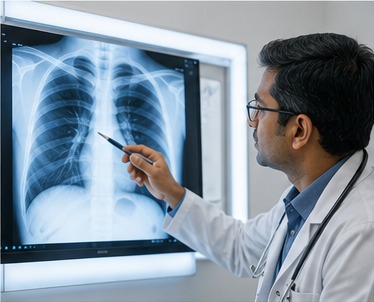
"Too many patients in Karimnagar come to us after months of self-treating a persistent cough with antibiotics or cough syrups. If your cough has lasted more than two weeks, get a CBNAAT test immediately — it is free and gives results in two hours," says Dr. Rajkumar Korra, MD (Pulmonology), Consultant Pulmonologist at Lalitha Chest & Skin Hospital, Karimnagar.
What Is Tuberculosis?
TB is an infection caused by a bacterium called Mycobacterium tuberculosis. It primarily attacks the lungs (pulmonary TB) but can also affect other parts of the body. The bacteria spread through the air when an infected person coughs, sneezes, or talks, releasing tiny droplet particles that can remain suspended in poorly ventilated indoor air for hours.
In most healthy people, the immune system contains the bacteria without causing illness — this is called latent TB infection. In approximately 10 percent of people, the bacteria eventually overcome the immune system and cause active TB disease.
Causes and Risk Factors
- Diabetes increases TB risk 2 to 3 times — one of the most important risk factors in India.
- HIV infection raises the risk 40 times.
- Malnutrition is the strongest global risk factor.
- Household contacts of smear-positive patients face 15 times the normal risk.
- Other factors: smoking (bidi or cigarette), alcohol use, overcrowded housing, immunosuppressive medications.
Latent TB vs Active TB
- Latent TB — Bacteria are present but contained. No symptoms, not infectious. Treated with TB Preventive Therapy (isoniazid for 6 months, free under NTEP).
- Active TB — Bacteria are multiplying and causing damage. Symptoms are present, and the person can spread TB to others. Requires immediate full-course treatment.
Symptoms of Tuberculosis
- Persistent cough lasting more than two weeks — The hallmark symptom. Prompt testing is essential.
- Blood in sputum (haemoptysis) — Coughing up blood or blood-streaked phlegm. A serious warning sign.
- Fever — Typically low-grade and worse in the evenings.
- Night sweats — Drenching sweats during sleep.
- Unexplained weight loss — Significant and progressive.
- Fatigue and weakness
- Chest pain that may worsen with breathing or coughing.
How Is TB Diagnosed?
- CBNAAT (GeneXpert) — A rapid PCR-based test that detects TB DNA in sputum within 2 hours and checks for rifampicin resistance. Available free at all NTEP centres.
- AFB Smear Microscopy — Quick, free, identifies the most infectious patients.
- Sputum Culture — The gold standard; provides full drug sensitivity testing. Free under NTEP.
- Chest X-ray — Shows characteristic upper lobe infiltrates, cavitation, or pleural effusion.
Treatment — The NTEP Regimen (Completely Free)
The standard treatment for drug-sensitive TB is a 6-month regimen:
- Intensive phase (2 months) — Four medicines daily: Isoniazid, Rifampicin, Pyrazinamide, and Ethambutol (HRZE).
- Continuation phase (4 months) — Isoniazid and Rifampicin (HR) daily.
Completing all six months without interruption is absolutely essential. Stopping early risks drug resistance, leading to MDR-TB which requires much longer treatment.
Financial Support During Treatment
- All TB diagnosis and medicines are completely free under NTEP.
- Nikshay Poshan Yojana provides ₹500/month into the patient's bank account for nutritional support.
- TB helpline: 1800-11-6666 (toll-free, 24 hours).
Prevention
- BCG vaccination at birth (part of India's universal immunisation programme)
- Contact tracing of all household members (free under NTEP)
- Good ventilation in homes and adequate nutrition
- Prompt testing for any cough lasting more than two weeks
Frequently Asked Questions
Q: Is TB curable in India?
Yes — drug-sensitive TB has an 85 to 90 percent cure rate with the standard 6-month NTEP regimen. Even MDR-TB has treatment success rates of 60 to 75 percent with modern Bedaquiline-based regimens. All testing and treatment is free.
Q: My father has TB. Should the rest of the family worry?
All household contacts of smear-positive TB patients must be screened. Symptomatic contacts should get CBNAAT immediately. Children under 5 receive TB Preventive Therapy (free). Contact the NTEP centre handling treatment — they are required to perform contact tracing.
Q: I was treated for TB 3 years ago. I am now coughing again. Has TB come back?
Relapse occurs in approximately 3 percent of treated patients. New symptoms must be investigated immediately with CBNAAT — do not restart old TB medicines without testing. Drug sensitivity testing is essential before retreatment.
Q: Will people find out about my TB diagnosis?
NTEP requires Nikshay registration for programme monitoring, but your records are not shared publicly. TB is nothing to be ashamed of — it is a curable infection.
Searching for a "TB specialist near me" or "tuberculosis treatment in Karimnagar"? Visit Lalitha Chest & Skin Hospital. Dr. Rajkumar Korra provides comprehensive TB evaluation, rapid CBNAAT testing, complete treatment supervision, and long-term follow-up. Book at +91 94413 59200.