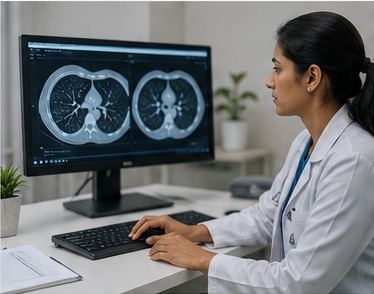
"Any patient who has smoked for 20 or more years and has a new cough, unexplained weight loss, or coughed up blood — this must be investigated the same week, not put off for months. Early-stage lung cancer is very treatable. Late-stage is a much harder battle," says Dr. Rajkumar Korra, MD (Pulmonology), Consultant Pulmonologist at Lalitha Chest & Skin Hospital, Karimnagar.
Types of Lung Cancer
There are two broad categories that guide treatment completely differently:
- Non-Small Cell Lung Cancer (NSCLC) — Accounts for 85 percent of cases. Includes adenocarcinoma (most common, particularly in non-smokers and women), squamous cell carcinoma (strongly linked to smoking, central airway location), and large cell carcinoma. Generally slower-growing than SCLC.
- Small Cell Lung Cancer (SCLC) — 15 percent of cases. Strongly linked to heavy smoking. Fast-growing and early-spreading. Very responsive to chemotherapy initially.
Risk Factors
- Tobacco smoking — Cigarettes and bidi are the dominant cause. Risk is proportional to the number of cigarettes per day and years of smoking. Quitting smoking at any age reduces risk.
- Passive smoke exposure — Living with a smoker doubles lifetime lung cancer risk.
- Radon exposure — Second most important cause in non-smokers worldwide (colourless, odourless gas from soil/rock).
- Occupational exposures — Asbestos, chromium, arsenic, and nickel.
- Air pollution — Long-term high PM2.5 exposure significantly increases risk.
- Previous lung disease — COPD and tuberculosis-scarred lungs have elevated risk.
Symptoms — Warning Signs to Act On
- Persistent cough lasting more than 3 to 4 weeks — Especially if new or changed character in a smoker
- Blood in sputum (haemoptysis) — Even a small amount must be investigated
- Unexplained weight loss — More than 5% body weight in 6 months
- Breathlessness — New or worsening without obvious explanation
- Chest pain — Persistent, dull chest pain particularly if worsened by breathing
- Hoarseness — Unexplained voice change (can indicate nerve involvement)
- Recurrent chest infections — Same area of lung repeatedly
- Bone pain, headache, or neurological symptoms — Possible signs of metastatic spread
Diagnosis
A chest X-ray is the first step but can miss early tumours. CT scan of the chest with contrast is the key staging investigation. Tissue diagnosis (biopsy) is essential before any treatment — performed via bronchoscopy, CT-guided biopsy, or thoracoscopy. Molecular testing (EGFR, ALK, ROS1, PD-L1) on the biopsy determines targeted therapy options.
Staging
Staging (Stage I through IV) determines whether curative treatment is possible. Stage I and II are potentially curable with surgery. Stage III may be managed with chemotherapy and radiation. Stage IV (spread to other organs) is managed with systemic therapies — but is not necessarily rapidly fatal, particularly with targeted therapy for eligible patients.
Treatment
- Surgery — The best chance of cure for early-stage NSCLC. Lobectomy (removal of a lung lobe) is standard. Requires sufficient lung reserve — spirometry assesses fitness.
- Radiation therapy — SBRT (stereotactic body radiation) for patients who cannot have surgery. Combined with chemotherapy for Stage III.
- Chemotherapy — Platinum-based combinations. First-line treatment for SCLC and advanced NSCLC without targetable mutations.
- Targeted therapy — Oral tablets (gefitinib, erlotinib, alectinib, osimertinib) for NSCLC with specific mutations (EGFR, ALK, ROS1). Dramatically improve quality of life and survival.
- Immunotherapy — Checkpoint inhibitors (pembrolizumab, nivolumab) activate the immune system against cancer cells. Effective for high PD-L1 expressing tumours.
Frequently Asked Questions
Q: I have never smoked. Can I still get lung cancer?
Yes. Approximately 15 percent of lung cancer cases occur in non-smokers — particularly adenocarcinoma, which is more common in women. Passive smoke exposure, radon, air pollution, and genetic factors can all contribute.
Q: Is lung cancer always fatal?
No. Stage I lung cancer, detected while it is small and localised, has a 5-year survival rate exceeding 60 percent after surgery. Early detection makes a profound difference. Even advanced lung cancer is increasingly manageable with targeted therapies.
Q: What is low-dose CT screening and who should have it?
Annual low-dose CT (LDCT) scanning is recommended in high-risk individuals — current or former heavy smokers aged 50 to 80 years. It detects lung cancers at earlier, more treatable stages. Ask Dr. Korra at your next consultation whether you are a candidate.
Q: I was diagnosed with Stage IV lung cancer 2 years ago. Should I give up?
Absolutely not. Stage IV NSCLC with EGFR mutation or ALK rearrangement treated with targeted therapy can achieve disease control for many years with good quality of life. Molecular testing of your tumour is essential to identify these opportunities. Please seek specialist pulmonology review.
Searching for "lung cancer specialist near me" or "pulmonology hospital in Karimnagar"? Visit Lalitha Chest & Skin Hospital. Dr. Rajkumar Korra provides comprehensive respiratory evaluation, bronchoscopy, and coordinates care with oncology for lung cancer management. Book at +91 94413 59200.