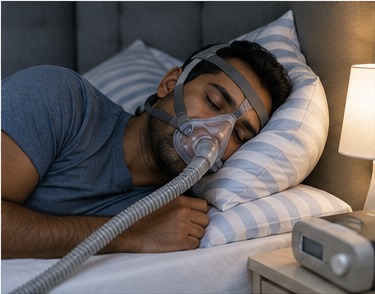
"Sleep apnea is one of the most under-diagnosed conditions in India — because patients don't observe themselves sleeping. They normalise their snoring and morning fatigue as 'just the way things are.' Once they start CPAP therapy, the transformation is remarkable — better sleep, better concentration, better blood pressure control," says Dr. Rajkumar Korra, MD (Pulmonology), Consultant Pulmonologist at Lalitha Chest & Skin Hospital, Karimnagar.
What Is Obstructive Sleep Apnea?
Obstructive sleep apnea (OSA) is a sleep disorder in which the upper airway repeatedly collapses during sleep, causing breathing to pause for 10 seconds or more — sometimes hundreds of times per night. Each pause (apnoea) causes oxygen levels in the blood to drop and briefly rouses the brain to restore breathing — preventing deep, restorative sleep. The person rarely remembers these arousals but wakes unrefreshed every morning.
Causes and Risk Factors
- Obesity — Excess fat around the neck and throat narrows the airway. Even a 10% weight gain significantly increases OSA risk.
- Anatomical factors — Large tonsils, small jaw, large tongue, deviated nasal septum
- Neck circumference — Above 40 cm in women and 43 cm in men significantly increases risk
- Age — Risk increases with age as throat muscle tone decreases
- Male sex — Men are 2 to 3 times more likely to have OSA than pre-menopausal women
- Alcohol and sedatives — Relax throat muscles, worsening apneas
- Sleeping on the back — Allows the tongue to fall back and obstruct the airway
Symptoms
- Loud, disruptive snoring — Often described by the bed partner as the primary problem
- Witnessed apnoeas — Bed partner observes the person stop breathing during sleep
- Waking with choking or gasping
- Unrefreshing sleep — Waking tired despite 7 to 8 hours in bed
- Excessive daytime sleepiness — Falling asleep during reading, meetings, or while driving
- Morning headaches
- Difficulty concentrating and memory problems
- Irritability and mood changes
- Frequent nocturnal urination
Why Untreated OSA Is Dangerous
Each apnoea stresses the cardiovascular system. Untreated severe OSA doubles the risk of high blood pressure, triples the risk of heart attack, and quadruples stroke risk. It significantly worsens diabetes control, increases motor vehicle accident risk from daytime sleepiness, and is associated with depression, erectile dysfunction, and accelerated cognitive decline.
Diagnosis — Polysomnography (Sleep Study)
The gold standard test is polysomnography — a comprehensive overnight study that measures brain waves, eye movements, muscle activity, heart rhythm, oxygen levels, airflow, and chest movement simultaneously. The Apnoea-Hypopnoea Index (AHI) grades severity:
- Mild OSA: 5 to 14 events per hour
- Moderate OSA: 15 to 29 events per hour
- Severe OSA: 30 or more events per hour
Treatment
- CPAP (Continuous Positive Airway Pressure) — The most effective treatment for moderate to severe OSA. A bedside machine delivers air through a comfortable mask, maintaining airway pressure during sleep to prevent collapse. Snoring stops on the first night. Energy, concentration, and blood pressure improve significantly within weeks of regular use.
- Lifestyle modifications — Weight loss, avoiding alcohol, positional therapy (avoiding sleeping on the back), and treating nasal congestion all improve OSA.
- Mandibular advancement device — A dental device that holds the jaw forward, suitable for mild to moderate OSA.
- Surgery — For structural causes (large tonsils, deviated septum) in selected patients.
Frequently Asked Questions
Q: Is snoring the same as sleep apnea?
Not necessarily. Snoring is the sound of partial airway obstruction. Sleep apnea occurs when the airway completely closes, causing breathing pauses. Not all snorers have sleep apnea, but all sleep apnea patients snore. A sleep study distinguishes them.
Q: Will I have to use CPAP forever?
CPAP treats OSA as long as it is used — it does not cure the underlying anatomy. However, significant weight loss sometimes resolves or greatly reduces OSA. Patients who lose significant weight often find they can reduce their CPAP pressure or even stop using it.
Q: The CPAP mask seems claustrophobic. Are there alternatives?
Modern CPAP masks are much more comfortable than older designs. A sleep specialist will trial different mask types to find one you can sleep in. Most patients adapt within 1 to 2 weeks. Auto-titrating CPAP (APAP) adjusts pressure automatically, further improving comfort.
Q: My husband snores loudly but says he sleeps fine. Should he get tested?
Yes. Most OSA patients feel they sleep fine and deny tiredness — because OSA-fragmented sleep is all they know. Loud snoring with observed pauses, morning headaches, or excessive daytime sleepiness are strong indications for a sleep study.
Searching for "sleep apnea treatment near me" or "CPAP therapy in Karimnagar"? Visit Lalitha Chest & Skin Hospital. Dr. Rajkumar Korra provides comprehensive sleep apnea diagnosis, sleep study referral, CPAP titration, and long-term management. Book at +91 94413 59200.