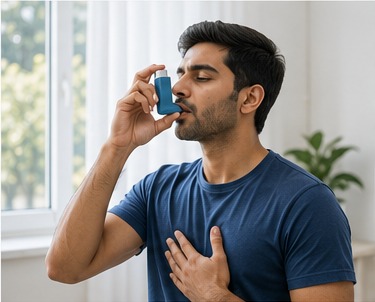
"If you or someone in your family has been experiencing recurring breathlessness, wheezing, or a persistent cough that comes and goes, do not ignore it. Early diagnosis and the right inhaler therapy can give you complete control over your symptoms," says Dr. Rajkumar Korra, MD (Pulmonology), Consultant Pulmonologist at Lalitha Chest & Skin Hospital, Karimnagar.
What Is Asthma?
Asthma is a chronic inflammatory disease of the airways — the tubes that carry air in and out of your lungs. In a person with asthma, three things happen: the inner lining of the airways becomes chronically inflamed and overly sensitive; these airways overreact to substances that are harmless to most people; and the airways narrow intermittently, causing breathlessness, wheezing, cough, and chest tightness.
The key characteristic of asthma is that this narrowing is largely reversible — either on its own or with treatment. This is what distinguishes asthma from COPD, where the damage is more permanent.
What Causes Asthma?
- Genetic factors — If asthma, eczema, or allergic rhinitis runs in your family, you are at significantly higher risk.
- Environmental triggers — House dust mites, outdoor air pollution (PM2.5), biomass cooking smoke from chulhas, tobacco and bidi smoke, pollen, and strong odours are common Indian triggers.
- Occupational causes — Textiles, construction, bakeries, healthcare (latex), and chemical industries can trigger adult-onset asthma.
- Respiratory infections — Viral infections — cold, flu, and COVID-19 — are among the most potent triggers for attacks in both children and adults.
Types of Asthma
- Allergic (Atopic) Asthma — The most common type, triggered by dust mites, pollen, pet dander, and mould. Often linked to hay fever and eczema.
- Non-Allergic Asthma — Triggered by infections, cold air, stress, or chemical fumes. More common in adult-onset asthma.
- Exercise-Induced Asthma — Causes chest tightness and wheezing a few minutes into physical activity, especially in cold or dry air. Frequently missed.
- Occupational Asthma — Develops due to exposure to workplace substances such as cotton dust, paint fumes, or flour dust.
- Cough-Variant Asthma — A persistent dry cough is the only symptom — no audible wheeze. Frequently misdiagnosed as chronic throat infection or TB in India.
- Severe Asthma — Does not respond adequately to standard treatment. Affects roughly 5 to 10 percent of asthma patients.
Symptoms of Asthma
- Breathlessness — Often described as not being able to take a full, satisfying breath.
- Wheezing — A high-pitched whistling sound when breathing, especially on breathing out.
- Chest tightness — Feels like pressure or squeezing in the chest; sometimes confused with a heart problem.
- Coughing — Often worse at night or early morning. Some people have cough as their only symptom for years.
A key pattern: asthma symptoms are typically worse at night or early morning, triggered by specific exposures, variable from day to day, and reversible with a reliever inhaler within 15 to 20 minutes.
Diagnosis at Lalitha Chest & Skin Hospital
Dr. Rajkumar Korra uses a comprehensive diagnostic approach including spirometry with bronchodilator reversibility testing (the gold standard), FeNO measurement to detect airway inflammation, allergy skin prick testing to identify specific triggers, and peak flow variability monitoring. These tests are available in-house, ensuring a complete evaluation in a single visit.
Treatment Overview
Asthma treatment follows a step-wise approach based on severity:
- Intermittent asthma — A reliever inhaler (salbutamol) used as needed.
- Mild persistent — A low-dose inhaled corticosteroid (ICS) such as budesonide added as a daily controller.
- Moderate persistent — Medium-dose ICS combined with a long-acting bronchodilator (LABA).
- Severe persistent — High-dose combination therapy; in some cases, biologic therapies such as omalizumab or dupilumab.
Non-medication strategies are equally important: dust mite-proof mattress covers, HEPA air purifiers, weight management, smoking cessation (free support: iQuit helpline 1800-11-2356), and annual influenza vaccination.
Emergency Signs — Call 102 or 108 Immediately
If you cannot speak in full sentences due to breathlessness, your lips turn blue, or your breathing does not improve with your reliever inhaler — seek emergency help immediately.
Frequently Asked Questions
Q: I only cough — I don't wheeze. Is this really asthma?
Yes. Cough-Variant Asthma is a well-recognised form where persistent dry cough — typically nocturnal and triggered by cold air, exercise, or allergens — is the only symptom. It responds to the same inhaler treatment as classical asthma.
Q: I use my salbutamol (blue inhaler) every day. Is this a problem?
Yes — daily use of a SABA rescue inhaler indicates inadequately controlled asthma. You need an inhaled corticosteroid (ICS) as a daily controller medicine. Please see a pulmonologist for a treatment review.
Q: Are steroid inhalers dangerous?
Inhaled corticosteroids are not the same as oral or bodybuilding steroids. They act locally on the airways at standard doses and are safe for long-term use. Rinsing your mouth after use prevents oral thrush.
Q: Can asthma be cured permanently?
Asthma is a chronic condition that cannot be permanently cured, but it can be completely controlled. With the right treatment, most patients achieve zero symptoms and a fully normal active life.
Searching for an "asthma specialist near me" or "best pulmonologist near me" in Karimnagar? Visit Lalitha Chest & Skin Hospital. Dr. Rajkumar Korra provides comprehensive asthma evaluation, allergy testing, inhaler technique training, and personalised Asthma Action Plans. Book at +91 94413 59200.