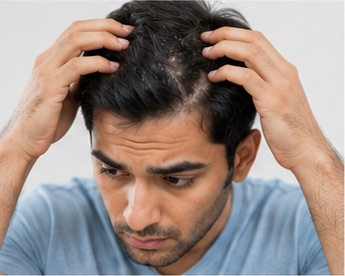
Scalp problems are among the most common reasons patients visit a dermatologist, yet they are also among the most underdiagnosed — because many people try to manage them with over-the-counter shampoos for months before seeking professional help. If your scalp is persistently itchy, flaky, sore, or if you are noticing patchy hair loss alongside a scalp condition, you need a proper diagnosis, not a general-purpose anti-dandruff product.
Dr. B. Jyothi at Lalitha Chest and Skin Hospital evaluates scalp conditions thoroughly, distinguishing between conditions that look similar on the surface but require very different treatments.
Common Scalp Disorders We See
Dandruff (Pityriasis capitis) is the mildest form of scalp inflammation. Fine, white or yellowish flakes are visible on the scalp and hair, accompanied by mild itching. It is related to an overgrowth of a naturally occurring yeast (Malassezia) and is usually manageable with appropriate medicated shampoos.
Seborrhoeic dermatitis is a more inflammatory version of dandruff, producing thicker, greasier flakes and significant redness and scaling that can extend beyond the hairline to the forehead, ears, and eyebrows. It is a chronic condition that requires ongoing management rather than a one-time cure.
Scalp psoriasis produces sharply defined, thick, silvery scales on a reddened base. It is often itchy and can extend beyond the hairline. It may occur in isolation or alongside psoriasis elsewhere on the body.
Tinea capitis (scalp ringworm) is a fungal infection that predominantly affects children, causing round bald patches with broken-off hairs, scaling, and sometimes inflammation severe enough to produce a boggy swelling called a kerion.
Folliculitis and scalp acne involve infected or inflamed hair follicles, causing painful bumps or pustules, most often at the back of the scalp or nape of the neck.
When to See a Dermatologist
You should not wait if you experience patchy hair loss alongside scalp scaling or inflammation, if your scalp symptoms have not responded to two rounds of over-the-counter treatment, if you notice sores, crusting, or oozing on the scalp, or if there is swelling in lymph nodes around your neck or behind your ears.
How Dr. Jyothi Diagnoses Scalp Conditions
In many cases, a careful clinical examination under dermoscopy — a magnified skin-surface examination — is sufficient. For fungal infections, a Wood's lamp examination or scalp scraping for microscopy and culture confirms the diagnosis. A scalp biopsy is occasionally needed for chronic, treatment-resistant conditions.
Treatment Approaches
Treatment is condition-specific and may involve medicated shampoos (selenium sulphide, ketoconazole, coal tar, zinc pyrithione), topical corticosteroids for inflammatory conditions, antifungal agents for tinea capitis, or systemic therapies for moderate-to-severe psoriasis. Dr. B. Jyothi also addresses contributing factors — stress, diet, hormonal factors, and hair-care practices — that perpetuate certain scalp disorders.
Take the First Step
If you are dealing with a persistent scalp condition, book a consultation with Dr. B. Jyothi at Lalitha Chest and Skin Hospital, Opp. Adharshnagar Board, Choppadandi Road, Karimnagar – 505001. Call +91 94413 59200 today. Your scalp health is worth a proper diagnosis.