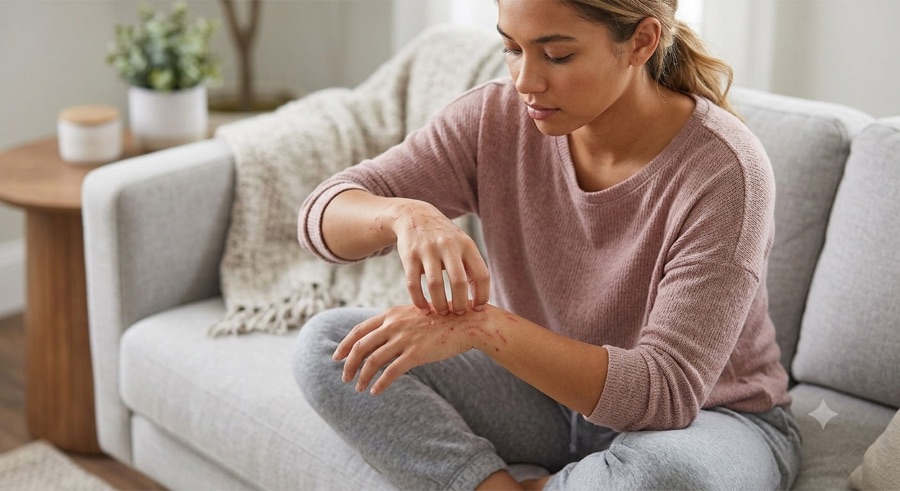
"Scabies is a common but easily treatable skin condition when identified early. Delayed treatment often results in severe itching and spread within families. With proper medical care and timely treatment of all close contacts, scabies can be completely cured," says Dr. B. Jyothi, Consultant Dermatologist, Lalitha Chest & Skin Hospital, Karimnagar.
What Is Scabies?
Scabies is caused by Sarcoptes scabiei — a microscopic mite that burrows into the upper layers of human skin, where it lays eggs. The intense itching is an allergic reaction to the mite, its eggs, and its waste products. A person with typical scabies carries only 10 to 15 mites on their entire body — but these cause significant misery. Scabies affects people of every age, background, and cleanliness level.
How Does Scabies Spread?
Scabies spreads through prolonged, close skin-to-skin contact — not from brief handshakes or sitting next to someone. Common routes include:
- Living in the same household — sharing a bed or close physical contact
- Sexual contact
- Crowded living conditions — dormitories, hostels, prisons
- Caring for an infected person — nursing home or childcare settings
- Sharing personal items such as bedding, clothing, or towels (less common)
Poor hygiene is NOT a cause of scabies — anyone can get infected regardless of how clean they are.
Symptoms of Scabies
- Intense itching — The hallmark symptom. Typically much worse at night and after a warm bath. Severe enough to regularly disrupt sleep.
- Burrows — Thin, wavy, greyish-white lines (2 to 10 mm long) in the skin — the mite's tunnels. Most visible between fingers, on wrists, and elbows.
- Rash — Small red bumps, blisters, or pimple-like sores across a wide distribution.
- Sores from scratching — Open, crusted, or bleeding areas. Can become secondarily infected with bacteria.
Common areas affected in adults: webs between fingers, wrists and inner elbows, armpits, waist and buttocks, genitals in men, around the nipples in women. In infants and young children, the scalp, face, palms, and soles are also commonly affected.
Symptoms appear 4 to 6 weeks after the first infestation. In re-exposure, symptoms can appear within 1 to 4 days as the immune system recognises the mite faster.
Crusted (Norwegian) Scabies
In elderly, immunocompromised, or malnourished patients, a severe form called crusted scabies can develop. The patient carries millions of mites (not just 15), causing thick, widespread, scaly crusts on the skin. It is extremely contagious and requires aggressive treatment with both topical and oral medication.
Diagnosis
Dr. B. Jyothi diagnoses scabies by examining the characteristic burrow pattern and rash distribution. A dermatoscope may be used to visualise mites in burrows. A skin scraping examined under a microscope can confirm the presence of mites, eggs, or faecal matter.
Treatment — The Golden Rule: Treat Everyone at the Same Time
Topical Treatments:
- Permethrin 5% Cream — The most effective and safest first-line treatment. Applied to all skin from neck to toes at night, left for 8 to 14 hours, then washed off. Repeated after 7 days.
- Benzyl Benzoate 25% Lotion — Widely used and effective in India. May cause temporary skin irritation.
- Crotamiton Cream — Less effective alone but has useful anti-itch properties.
Oral Treatment:
- Ivermectin — A single oral dose, repeated after 2 weeks. Particularly useful for crusted scabies or when topical treatment is impractical.
Managing the Itch: Antihistamines and mild topical steroid creams relieve itching during and after treatment. Itching may persist for 2 to 6 weeks after successful treatment — this is a normal allergic response and does NOT mean treatment has failed.
Home Care and Preventing Reinfection
- Treat ALL household members and close contacts on the same day — even those without symptoms. This is the most critical step.
- Wash all clothing, bedding, and towels used in the past 3 days in hot water (at least 60°C) and dry on high heat.
- Items that cannot be washed should be sealed in a plastic bag for 72 hours — mites cannot survive off the human body for more than 2 to 3 days.
- Vacuum floors, sofas, and mattresses thoroughly.
- Do not share clothing, towels, or bedding until treatment is complete.
When to See a Doctor Immediately
- Itching that is worsening rather than improving after treatment
- New burrows appearing after completing treatment
- Signs of skin infection — swelling, pus, increasing redness
- Any household member developing symptoms
Frequently Asked Questions
Q: I was treated last month and still itch. Has the treatment failed?
Itching can persist for 4 to 6 weeks after successful treatment due to the ongoing allergic reaction. Only if new burrows appear, or itching is worsening, should you see your doctor for re-evaluation.
Q: Do I need to fumigate my house?
No. Scabies mites cannot survive more than 48 to 72 hours off the human body. Thorough washing of bedding, vacuuming, and the 72-hour bag method is sufficient. Fumigation is unnecessary.
Q: Can my child go back to school after treatment?
Children should stay home until they have completed at least one full treatment application. After treatment, they are generally no longer contagious. Inform the school so other contacts can be checked.
Q: Can pets spread scabies to humans?
Animal scabies (mange) is caused by a different mite species that can cause temporary irritation in humans but does not establish a permanent human infestation. Have your pet treated by a veterinarian.
Searching for "scabies treatment near me" or a "skin specialist near me in Karimnagar"? Visit Lalitha Chest & Skin Hospital. Dr. B. Jyothi provides accurate diagnosis and a complete household treatment plan for scabies. Book your appointment at +91 94413 59200.