"Psoriasis is a systemic condition — not just a skin problem. Some patients develop psoriatic arthritis, which can be severely disabling if not treated early. And we now have treatments that can achieve near-complete skin clearance. No patient with significant psoriasis should accept living with it untreated," says Dr. B. Jyothi, Consultant Dermatologist, Lalitha Chest & Skin Hospital, Karimnagar.
What Is Psoriasis?
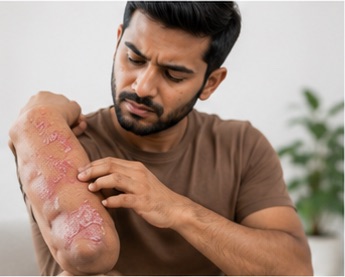
Psoriasis is an immune-mediated disease where T-cells in the immune system are overactivated, driving skin cells (keratinocytes) to reproduce at 10 times the normal rate. Instead of taking 28 to 30 days to mature and shed, skin cells turn over in 3 to 4 days, piling up as thick, silvery scales on a red or inflamed base. These patches (plaques) are the hallmark of plaque psoriasis — the most common type.
Types of Psoriasis
- Plaque psoriasis — Most common (80–90%). Well-defined red plaques with silvery-white scales. Scalp, elbows, knees, and lower back are most affected.
- Guttate psoriasis — Small drop-shaped patches, often triggered by streptococcal throat infection. Common in younger patients.
- Inverse (flexural) psoriasis — Smooth, shiny red patches in skin folds — armpits, groin, and beneath the breasts.
- Pustular psoriasis — White pustules on red skin. Severe form requiring urgent treatment.
- Erythrodermic psoriasis — Widespread redness covering most of the body. A dermatological emergency.
Psoriatic Arthritis
Up to 30 percent of psoriasis patients develop psoriatic arthritis — joint pain, stiffness, and swelling that can be severely disabling. It can develop before, with, or after skin psoriasis. Joint symptoms (especially morning stiffness or swollen fingers and toes "sausage digits") in a patient with psoriasis require urgent evaluation.
Triggers
- Stress and psychological trauma
- Streptococcal infections (especially in guttate type)
- Certain medications (lithium, beta-blockers, antimalarials, NSAIDs)
- Skin injury (Koebner phenomenon — new plaques appearing at injury sites)
- Smoking and alcohol
Treatment
1. Topical therapy (mild to moderate):
- Topical corticosteroids — Mainstay of mild plaque psoriasis
- Vitamin D analogues (calcipotriol) — Reduce skin cell turnover
- Coal tar preparations — Effective for scalp psoriasis
- Salicylic acid — Removes thick scale to allow better topical penetration
2. Phototherapy (moderate to severe): Narrowband UVB (NB-UVB) phototherapy — 2 to 3 sessions per week. Highly effective and safe for widespread plaque psoriasis. Typically achieves significant clearance in 30 to 40 sessions.
3. Systemic therapies (moderate to severe):
- Methotrexate — Weekly tablet or injection. Effective and inexpensive. Requires monitoring.
- Cyclosporine — Fast-acting for severe flares. Limited to short courses.
- Acitretin (oral retinoid) — Particularly useful for pustular psoriasis.
4. Biologics (severe/refractory psoriasis): IL-17 inhibitors (secukinumab, ixekizumab), IL-23 inhibitors (guselkumab, risankizumab), and TNF inhibitors (adalimumab, etanercept) achieve PASI 90 to 100 responses (90 to 100 percent skin clearance) in most patients. Injectable biologics are available in India and are now covered by some insurance plans.
Lifestyle Factors
- Moisturise daily to prevent skin cracking
- Avoid triggers — manage stress, quit smoking, minimise alcohol
- Maintain healthy weight — obesity significantly worsens psoriasis
- Use gentle, fragrance-free skincare products
Frequently Asked Questions
Q: Is psoriasis contagious?
No. Psoriasis is not contagious and cannot be passed from person to person. It is an immune disorder.
Q: Is psoriasis caused by diet?
No specific diet cures psoriasis, but maintaining a healthy weight and avoiding alcohol reduces severity significantly. Gluten elimination helps only in the small subset of patients with confirmed gluten sensitivity.
Q: Can psoriasis affect my joints?
Yes — psoriatic arthritis affects up to 30 percent of patients. If you have psoriasis and develop joint pain or stiffness, see a dermatologist and rheumatologist urgently. Early treatment prevents joint destruction.
Q: Biologics seem very expensive. Are there affordable options?
Yes. Several biologics are now manufactured as biosimilars in India at significantly reduced cost. Government insurance schemes (Aarogyasri, Ayushman Bharat) may cover biologic therapy for severe psoriasis. Ask Dr. Jyothi about options at your consultation.
Searching for "psoriasis doctor near me" or "skin specialist in Karimnagar"? Visit Lalitha Chest & Skin Hospital. Dr. B. Jyothi provides complete psoriasis assessment and a personalised treatment plan — from topicals to biologics. Book at +91 94413 59200.